

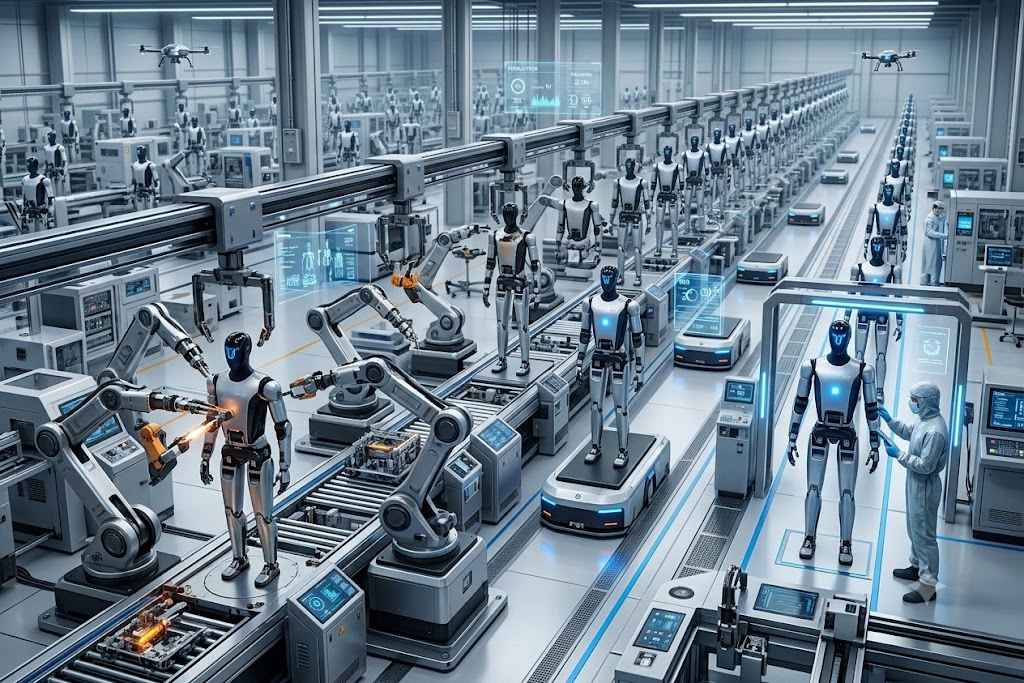
The global race for automation has entered a sci-fi reality. Walking through advanced manufacturing hubs in China today, you are no longer just seeing robotic arms welding car parts; you are witnessing the birth of mass-produced humanoid robots. Driven by ambitious government mandates and breakthroughs in artificial intelligence, China is aggressively positioning itself to become the undisputed global factory for human-like machines.
By scaling up production lines, these robots are rapidly moving from tech lab curiosities to active workers on factory floors and commercial spaces.
1. The Blueprint: Beijing’s Ambitious Mandate
China’s sudden acceleration into humanoid robotics isn’t an accident—it is a highly coordinated state strategy. The Ministry of Industry and Information Technology (MIIT) established a definitive blueprint aiming to establish an innovative system for humanoid robots, achieve mass production of these units, and build a robust supply chain.
-
The Target: The goal is to integrate these mass-produced synthetics deeply into the manufacturing ecosystem, service sectors, and harsh environmental operations.
-
The Driver: Faced with a shifting demographic landscape and a shrinking manufacturing workforce, China views mass-produced humanoid robots as the ultimate solution to sustain its economic productivity.
2. From Laboratories to Assembly Lines
Unlike Western counterparts that often focus on highly specialized, expensive single units, Chinese tech companies are prioritizing affordability, speed, and sheer volume.
By utilizing existing smartphone and electric vehicle (EV) supply chains, these companies have managed to slash the production costs of gears, actuators, and sensors, making mass deployment economically viable for factories.
3. The Secret Sauce: Brains Powered by AI
A humanoid robot is just a heavy piece of metal without a proper brain. The recent explosion in mass production is heavily tied to advancements in Embodied AI—giving AI models a physical body to interact with the real world.
-
Sensory Processing: These robots utilize multimodal AI. They can see a cluttered factory table, understand a verbal command like “sort the defective gears,” and execute the task autonomously.
-
Machine Learning: Instead of being rigidly programmed for one specific task, mass-produced robots are trained in virtual simulations millions of times before they ever step onto a real factory floor. This allows them to adapt instantly to new environments.
4. How Will This Impact the Global Economy?
The massive influx of affordable, mass-produced robots is set to trigger a ripple effect across the globe.
Deflationary Tech Pressures
Just as China drastically lowered the global cost of solar panels and electric vehicles through aggressive scaling, its entry into mass-market robotics could make humanoid workers affordable for medium and small businesses worldwide. Experts predict the cost of a basic humanoid robot could eventually drop to the price of a standard sedan.
The Future of Labor
While critics raise concerns over immediate job displacement in manufacturing and logistics, proponents argue that these robots will handle dangerous, repetitive, and ergonomically hazardous tasks. This allows human workers to pivot toward supervisory, programming, and creative roles.
Conclusion: The Humanoid Era is Here
The mass production of humanoid robots in China marks a definitive turning point in human history. We are transitioning from an era where robots were locked in safety cages to a new reality where they walk beside us as colleagues, caregivers, and assistants.
As assembly lines continue to roll out thousands of units every month, the question is no longer if humanoid robots will become a part of daily life, but how fast the rest of the world can adapt to this newly automated landscape.