

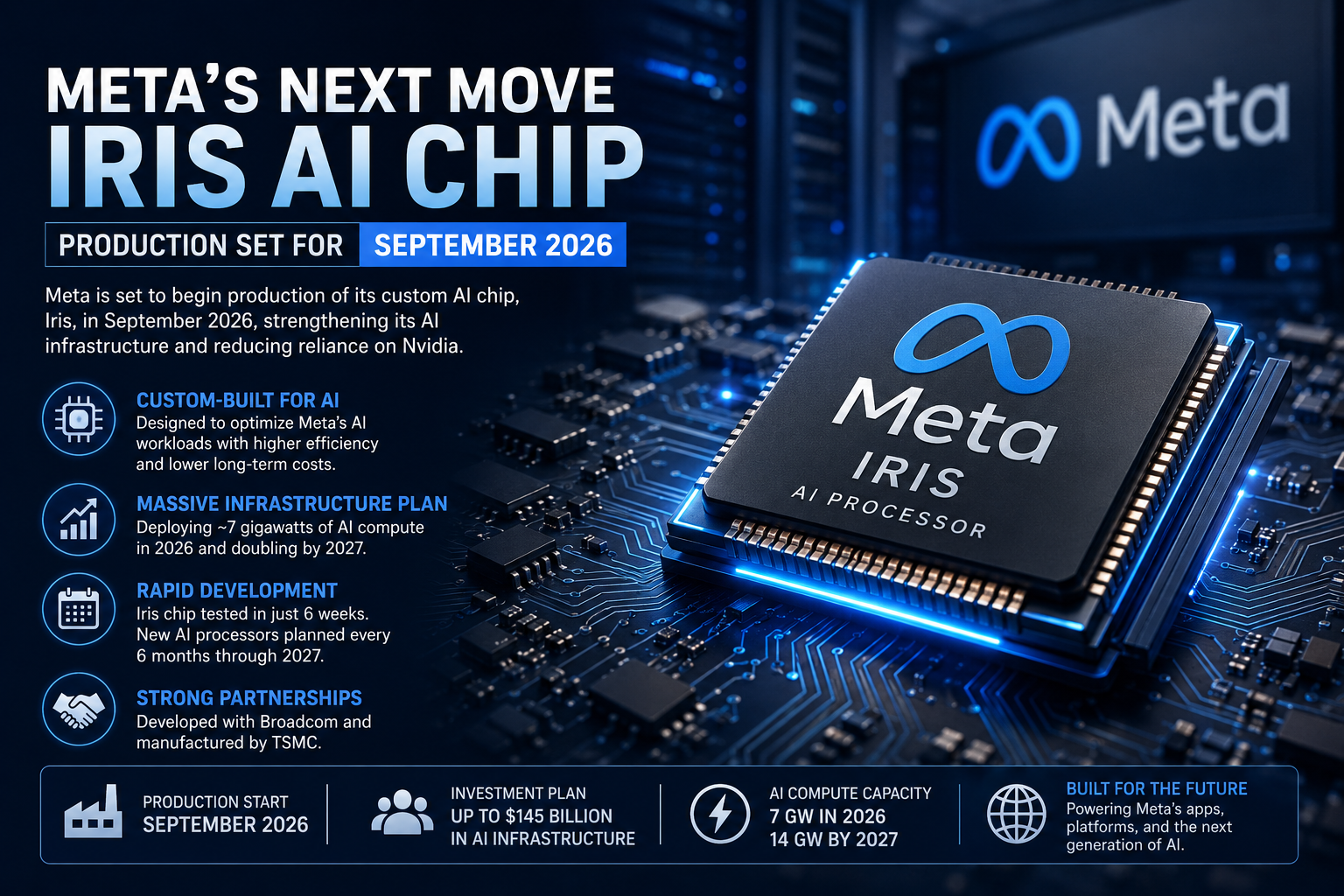
Meta is taking another major step in the artificial intelligence race by preparing to begin production of its first next-generation in-house AI chip, Iris, in September 2026. The move signals the company’s growing ambition to reduce reliance on third-party hardware suppliers while expanding its massive AI infrastructure across products including Facebook, Instagram, WhatsApp, and its AI assistant ecosystem.
The announcement comes as technology giants continue investing billions of dollars in custom silicon to gain greater control over AI performance, costs, and scalability.
Why Meta Is Building Its Own AI Chips
Meta has traditionally relied on graphics processors from Nvidia and AMD to train and run large AI models. However, soaring demand for AI hardware and supply chain constraints have encouraged major technology companies to develop proprietary processors.
The new Iris chip is expected to become a key component of Meta’s long-term AI infrastructure strategy.
Key objectives include:
- Lower dependence on external GPU suppliers
- Improve AI processing efficiency
- Reduce long-term infrastructure costs
- Optimize hardware specifically for Meta’s AI workloads
- Expand computing capacity significantly over the next two years
Industry analysts see this as one of Meta’s most important hardware initiatives since the launch of its Meta Training and Inference Accelerator (MTIA) program.
Iris Chip Development Progress
According to recent reports, Meta completed testing of the Iris processor in just six weeks—a remarkably fast development cycle compared to previous custom chip projects.
The chip is being developed in partnership with Broadcom, while manufacturing will be handled by Taiwan Semiconductor Manufacturing Company (TSMC).
Planned Release Schedule
Meta reportedly intends to release new AI processors approximately every six months through 2027, creating a steady pipeline of increasingly capable custom hardware.
This accelerated roadmap reflects the intense competition among leading AI companies seeking greater independence from traditional GPU vendors.